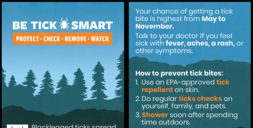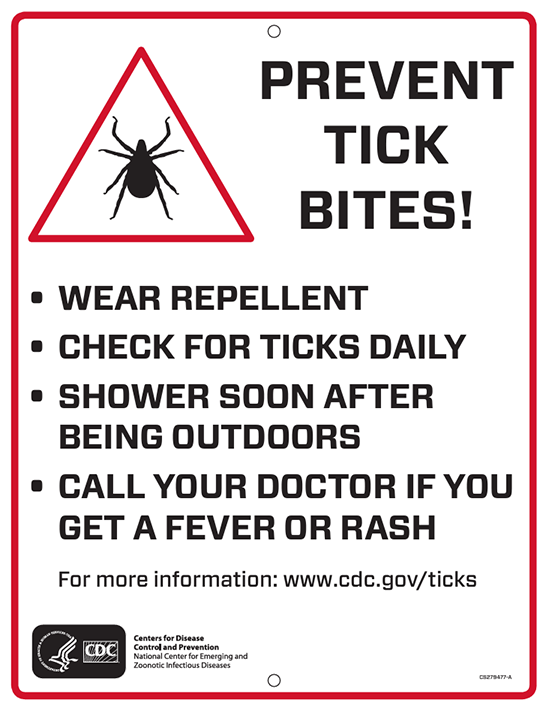

Be Tick Smart graphic

Whenever you spend time outdoors in Vermont, it’s possible there are ticks nearby.

Ticks can spread diseases through their bites. Take simple steps to protect yourself and your loved ones:

  • Protect – Avoid tick habitat, use repellent, wear protective clothing, and protect your pets.

  • Check – Check yourself, children, pets, and gear after spending time outdoors.

  • Remove – Remove attached ticks as soon as possible with fine-tipped tweezers.

  • Watch – Watch for symptoms for 30 days after a tick bite and contact your healthcare provider if you become sick.

Found an attached tick?

Use the Tick Bite Guide for information on what to do next.


Protect

1. Avoid areas where ticks live

Ticks are common throughout Vermont whenever temperatures are above freezing. They thrive in wooded and brushy areas with tall grass, shrubs, and leaf litter. You'll often find them along the edges of backyards, farms, trails, and sports fields. Ticks feed on animals such as deer, mice, and chipmunks, so they're often found where these animals live or travel.

  • Walk in the center of trails and avoid brushing against tall grass and vegetation.
  • Avoid brushing against tall grass and vegetation along trail edges.
  • Keep your yard well maintained: keep grass mowed, trim back brush, and remove leaf litter to help reduce tick habitat.

Did you know? Ticks stay low to the ground. They can’t fly or jump—instead, they wait on grasses and other vegetation and cling to people or animals as they brush past. This is called questing!

2. Wear protective clothing and gear

The clothing you wear can help prevent ticks from reaching your skin and make them easier to spot.

  • Wear pants, long-sleeved shirts, long socks, and boots when spending time outdoors.
  • Choose light-colored clothing to make it easier to spot ticks.
  • Treat clothing and gear with 0.5% permethrin. Never apply permethrin directly to skin. Permethrin kills ticks on contact and continues to protect through several washes. You can also buy pre-treated clothing and gear.
3. Use insect repellent

EPA-registered insect repellents are a safe and effective way to help prevent tick bites when used as directed.

  • Use an EPA-registered insect repellent that's right for your needs. The EPA's search tool can help you compare products based on the length of protection, the pests you want to repel, and the active ingredient.
  • Look for one of these active ingredients: 
    • DEET
    • Picaridin
    • IR3535
    • Oil of Lemon Eucalyptus (OLE)
    • Para-menthane-diol (PMD)
    • 2-undecanone
  • Always follow the product label instructions.
  • Do not use products containing OLE or PMD on children younger than 3 years old.
4. Protect and check your pets

Pets, especially dogs and outdoor cats, can bring ticks into your home.

  • Talk to your veterinarian about the best tick prevention products for your pet, such as oral medications, topical treatments, or tick collars. 
  • Check your pets carefully for ticks after they've been outdoors.
  • Remove any ticks promptly using fine-tipped tweezers.
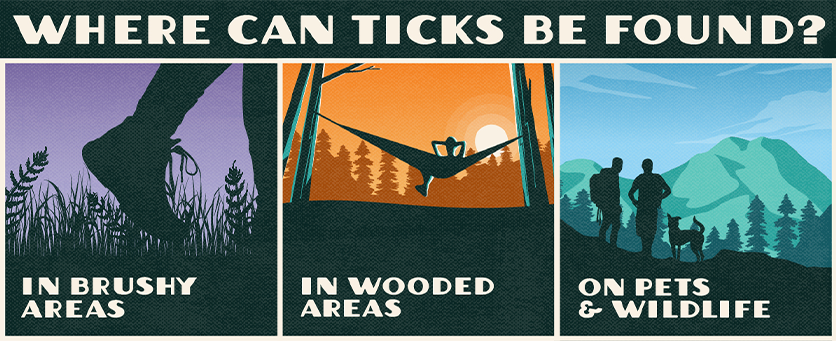
Where can ticks be found graphic

Check

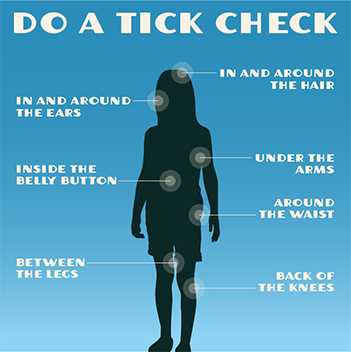
Tick check graphic

Checking for ticks as soon as you come indoors can help you find and remove them before they have a chance to spread disease.

  • Check your clothing, gear, and pets for ticks before going inside.
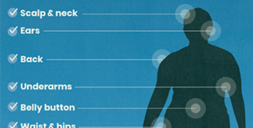
  • Perform a full-body tick check on yourself and your child. Pay close attention to your underarms, in and around your ears, around your waist, behind your knees, between your legs, around your belly button, in your hair, and along your hairline. Use a handheld or full-length mirror to help check hard-to-see areas.
  • Shower within two hours after coming indoors to help wash off unattached ticks and make it easier to find any that are attached.
  • Dry your clothes on high heat for at least 10 minutes to kill ticks. If clothes are damp, they may need more time. If your clothes require washing first, use hot water, as cold or warm water will not kill ticks.

Remove

Remove attached ticks as soon as you find them. The longer an infected tick stays attached, the greater the chance it can spread disease. Most ticks can be removed safely at home.

Finding an attached tick might be scary. You usually don't need to visit a healthcare provider or the emergency department just to have a tick removed. If the tick is in a hard-to-reach area, ask someone you trust to help.

  1. Use clean, fine-tipped tweezers or a tick removal tool to grasp the tick as close to the skin’s surface as possible.
  2. Pull the tick straight upward with steady, even pressure. Don’t twist or jerk the tick as this can cause the mouthparts to break off and remain in the skin. 
    1. If the mouthparts remain in the skin, try to remove them with tweezers. If you can't remove them easily, leave it alone and let the skin heal.
  3. Clean the bite area and your hands with soap and water or rubbing alcohol.
  4. Dispose of the tick safely by placing it in alcohol, sealing it in a bag or container, wrapping it tightly in tape, or flushing it down the toilet. Never crush a tick with your fingers.

Did you know? Many people won’t notice that they’ve had a tick bite. Tick bites don’t hurt—and may or may not itch. If you don't find the tick and remove it first, it will fall off on its own once it is full. This usually happens after a few days, but it can sometimes take up to two weeks.

Frequently Asked Questions

When are antibiotics recommended after a tick bite?

Generally, the routine use of antibiotics is not recommended by infectious disease experts after a tick bite. However, healthcare providers may prescribe a single dose of antibiotics to help prevent Lyme disease after a tick bite if all of the following are true:

  • The tick can be identified as a blacklegged tick.
  • The tick was attached for 36 hours or longer.
  • The antibiotic can be started within 72 hours of removing the tick.
  • Antibiotics are safe for you to take.
  • The tick bite occurred in an area where Lyme disease is common. If you were bitten anywhere in Vermont or a neighboring state, this criterion is generally met.

This type of treatment, called post-exposure prophylaxis (PEP), is not recommended as a way to prevent other tick bite illnesses such as anaplasmosis, babesiosis or ehrlichiosis.

If you don't meet the criteria for preventive antibiotics, the best approach is to watch for symptoms for 30 days and contact your healthcare provider if you become sick.

Should removed ticks be sent in for testing?

The Vermont Department of Health does not recommend testing ticks that have been removed from people or pets. Tick test results should not be used to make healthcare decisions for several reasons:

  • A positive test result doesn't mean you were infected. Even if a tick carries a disease-causing germ, it may not have transmitted the infection to you.
  • Negative results can lead to false assurance. You may have been bitten by a different infected tick without realizing it.
  • Testing may delay treatment. Results often take several days and may not be available when treatment decisions need to be made.
  • Tests performed on ticks are not held to the same standards as tests performed on humans. Results of tick testing should not be used for treatment decisions.

Even if a tick tests negative, people should still watch for symptoms such as a rash, fever, and flu-like symptoms. If any occur, contact your healthcare provider.

Some private laboratories offer tick testing. The Vermont Department of Health and Vermont Agency of Agriculture, Food and Markets do not collect or test ticks submitted by the public.


Watch

Watch for symptoms for 30 days after a tick bite. Early diagnosis and treatment can help prevent serious illness.

  • Watch for symptoms of a tick bite illness such as fever, chills, rash, headache, joint pain, muscle aches, fatigue, or a rash. 
  • Know what a Lyme disease rash looks like. Most people with Lyme disease develop a rash that begins near the tick bite and gradually expands. It may develop a bull's-eye appearance, but not all Lyme disease rashes look this way. Other tick-borne illnesses in Vermont typically do not cause a rash.
  • Contact your healthcare provider if you develop symptoms after a tick bite. Tell them when the bite occurred and about any recent outdoor activities or possible tick exposure.
  • Seek treatment promptly. Some tick bite illnesses can be treated with a short course of antibiotics. Most people who begin treatment early on fully recover.

Did you know?

Take Back Your Yard: Tick Prevention with Integrated Pest Management

Small, simple changes to your yard can make it less welcoming to ticks:

  • Trim dense vegetation, mow regularly, and remove invasive plants.
  • Keep yards sunny and dry.
  • Keep woodpiles away from your home.
  • Discourage wildlife by fencing yards and cleaning up food sources like birdseed, berries and apples.

Download our factsheet and read more about creating a tick-safe home (CDC)


Resources for Partners

Messaging Toolkit

This toolkit provides ready-to-use messages and resources to support community partners in sharing clear, accurate information about tick bite prevention with your audiences.

Download the toolkit

Free, Professionally Printed Materials

Order Now

Last Updated: