Treat your water if it has high levels of contaminants.

If you have high levels of contaminants in your drinking water, the Health Department recommends treating your water. You can install a home water treatment system to lower or remove contaminants for health concerns or for nuisances such as bad taste, odor or color.

What to Do First

Before deciding on a water treatment system for your home, it is important to complete all the recommended drinking water testing. This is because there are many considerations when choosing the best and safest water treatment system. For example, a water softener can be used to treat hardness, iron and radium, but it will not remove arsenic.

Pretreatment is sometimes necessary for some treatment systems. This is because some contaminants (usually hardness, iron or manganese) can make the treatment system less effective at removing the contaminant you want it to.

The Health Department recommends contacting a water treatment specialist to get the most up-to-date treatment information and estimates. It is usually a good idea to get estimates and treatment recommendations from more than one water treatment specialist before you make your decision. Once the system is installed, you will need to maintain it. Be sure to ask for maintenance cost estimates, too.

Treatment System Options

Treatment systems are divided into two categories:

  • Point-of-entry treatment (POET) systems are typically installed as water comes into a home and treat all the water in your home.
  • Point-of-use (POU) systems are typically installed under or by the kitchen sink and treat only the water used for drinking and cooking.

Below you will find an overview of treatment system options. When selecting a treatment system make sure it is NSF-certified.

It is always important to re-test after any treatment system is installed to ensure it is working properly. If you have already done the recommended testing, you can choose to test only for the contaminant the treatment system was installed for. Find information on water testing

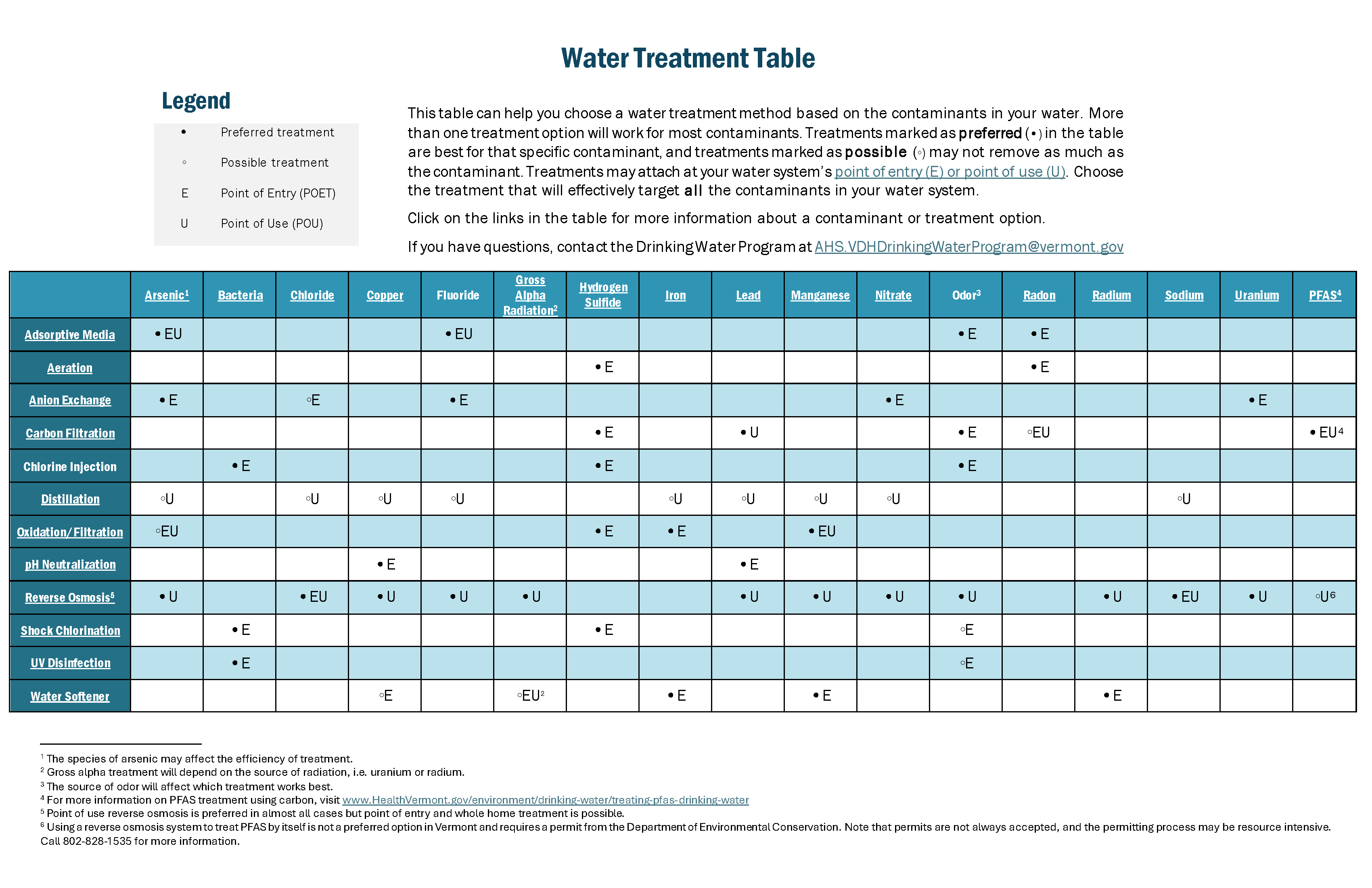
Water Treatment Table

Use this table to choose the best treatment for your water system based on your contaminant results.

New

Watch the water treatment table tutorial video to help you understand how to use the table.

Important

For any treatment, be sure to maintain the system and replace filters regularly. Follow the manufacturer's or water treatment specialist's instructions to make sure the system works properly.

Adsorptive media

Adsorptive media filtration systems are used to lower arsenic, fluoride and radon levels. An adsorptive filtration system is typically installed as a whole-house system (POET). In adsorptive filtration, the contaminant sticks to the surface of a specially designed filter as the water passes through. For example, you may choose an activated alumina and granular ferric (iron) hydroxides adsorptive filter to lower arsenic.

If you are installing an adsorptive filtration system to reduce a contaminant with a health effect, make sure to install a system with an NSF/ANSI Standard 53 Certification or Water Quality Association Gold Seal

Aeration

Aeration systems release gas like radon and hydrogen sulfide from water. They can also lower levels of iron, manganese, and sulfur in your water. Aeration is typically installed as a whole house system (POET).

Aeration systems force large amounts of air through water and then vent to the outside. They can also add oxygen to water to make dissolved contaminants solid, so that they fall out of the water as particles.

This type of treatment is typically installed in combination with a filter that uses media to catch the particles that fall out.

Anion exchange

Anion exchange units are typically used to lower levels of nitrate but can also lower levels of uranium, sulfate and fluoride. Anion exchange can be used to treat chloride, but this is typically not recommended.

Anion exchange is typically installed as a whole house system (POET). Anion exchange is like a water softener but uses a different media that exchanges the contaminant for another anion (negatively charged ion) like chloride.

Anion exchange units lower the pH, which can make the treated water more corrosive. This can cause issues with lead and copper plumbing and fixtures. If you have metal plumbing, it is necessary to follow the anion exchange unit with a neutralizing system.

Iron and turbidity may clog anion exchange units, so pretreatment to remove iron or turbidity may also be necessary. Look for products with an NSF/ANSI Standard 53 Certification or Water Quality Association seal.

Carbon filtration

Carbon filters are often used to remove general taste and odor problems. Carbon filters are also effective at removing organic compounds and gases such as PFAS and radon.

These systems can be installed as a whole house system (POET), but are more frequently installed at or under the kitchen sink (POU). They use a filter with carbon in it. As the water moves through the filter, the contaminant is trapped by the carbon until the filter is saturated.

Since the carbon filter can remove other minerals found in your water, it is difficult to know how long it will last. Some large carbon filters have been known to last for years, while some small filters may last for only weeks. Make sure to install a system with an NSF/ANSI Standard 42 or 53 Certification or Water Quality Association Gold Seal.

Distillation

Distillation units treat many different kinds of inorganic contaminants. They are typically installed at or under the kitchen sink (POU). They boil water and then condense the steam. The contaminant is left behind during this process, along with hardness and other minerals.

A pre-treatment system may be needed when using distillation to treat some contaminants. Distillation uses a lot of energy to heat the water and form steam. Make sure to install a distillation unit with an NSF/ANSI Standard 62 Certification or Water Quality Association Gold Seal.

Flushing

Flushing is a temporary solution to lower levels of lead and copper until a permanent solution has been chosen.

To flush, let the cold water run until it is as cold as it can get. This means the water is drawn directly from the well or the town water main. This flush should be done if the water has been sitting in the pipes for more than six hours, which is usually first thing in the morning or after the workday. 

Flushing out water that has been sitting in pipes can sometimes lower levels of lead and/or copper in your water below the health advisory level. Test the water after flushing using this method to show that flushing was successful in lowering the lead and/or copper levels.

Neutralization

Neutralization makes water less likely to dissolve lead and copper from a home's plumbing system. These systems are typically installed as a whole house system (POET). Neutralizaton is usually required after installing a POET reverse osmosis or anion exchange system.

Neutralizers are added to the water to make it less acidic by increasing alkalinity and pH. The most common neutralizing media are marble, calcium carbonate, soda ash or lime.

Oxidation and filtration with chemicals

An oxidizing chemical is added to the water to convert the dissolved contaminant (typically iron or manganese) in the water into a solid form so that it can be filtered out of the water.

For manganese, a strong oxidizing chemical such as chlorine or permanganate is required. OxidizWater Quality Association Gold Sealemicals require careful safety precautions, calibration, maintenance, and monitoring. Make sure to install a system with an NSF/ANSI Standard 42 or 53 Certification orQuality Associr Quality An Gold Seal.

Oxidizing filtration media

When an oxidizing catalyst filter media is used, the dissolved iron or manganese attaches to the coating on the filter. The iron or manganese is then converted to a solid form and filtered out. Make sure to install a system with an NSF/ANSI Standard 42 or 53 Certification or Water Quality Association Gold Seal.

Plumbing and fixture replacement

Replacing old plumbing with newer materials can lower concentrations of lead and copper in your water. Older plumbing and fixtures (like a kitchen faucet) are more likely to contain higher concentrations of lead and copper than new materials. Make sure to choose fixtures that meet lead-free certification standards.

It is important to clean aerators and flush new fixtures and plumbing after you have replaced any plumbing or fixtures. This helps to remove any lead particles that were dislodged during remediation.

Reverse osmosis

Reverse osmosis (RO) systems treat contaminants such as arsenic, fluoride, gross alpha radiation, copper, uranium, lead and nitrate. Be sure any product you use is certified to remove the specific contaminants in your water.

These systems are installed as a separate tap by the kitchen sink (POU). They use a synthetic membrane that allows water to pass through but leaves the contaminant behind. The membrane is continually rinsed.

RO treatment efficiency is only about 25%, which means that for every 1 gallon of treated water, there will be 3 to 4 gallons wasted. This is why it is best as a POU system at a kitchen sink instead of a POET system that treats all the water in your house. The filtered water is stored in a small pressure tank and dispensed through a dedicated tap and the wasted water is directed to the septic system or a drywell.

Hard water can cause scale on RO membranes and a pre-treatment system may be needed, such as a water softener. Be sure to read the manufacturer’s instructions for the maximum hardness concentration of your water before it goes through the RO membrane. In general, hardness concentrations should not be higher than 120 to 170 mg/L (milligrams per liter) or 7 to 10 grains per gallon. Make sure to install an RO system with an NSF/ANSI Standard 58 Certification or Water Quality Association Gold Seal.

Shock chlorination

Shock chlorinatioin, or shock disinfection, is for drinking water contaminated with bacteria after repairs have been made to the system. Shock chlorination is not intended as a solution for a bacteria problem that keeps occurring.

You can disinfect your own well and water system or can contact a licensed well driller for assistance.

Chlorine injection

Continuous chlorination is one of several permanent solutions to contamination from bacteria. It is typically installed as a whole house system (POET). It will disinfect water as it comes into your home by injecting small amounts of chlorine into your plumbing system when the water is being pumped into the home.

Ultraviolet (UV) light

Ultraviolet (UV) light treats bacteria and other pathogens. UV treatment can disinfect water without the use of chemicals. This treatment is typically installed as a whole house system (POET). The effectiveness of UV light in killing microorganisms is directly related to the bulb’s intensity and exposure time, so it's important to choose the right size for your water use.

Pretreatment is often necessary if there are water quality issues that may block the UV light, such as tannins, suspended sediment, scaling (due to hard water) and turbidity. Bulbs need to be replaced and cleaned regularly. Make sure you install a UV light treatment system with an NSF/ANSI Standard 55 Certification or Water Quality Association Gold Seal.

Water softener

Water softeners are typically used to remove hardness but can also remove contaminants such as radium, iron and manganese.

A conventional water softener (also called a cation exchange system) is typically installed as a whole house system (POET). It exchanges the contaminant for sodium or potassium, which remains in the water. The contaminant is flushed away with the wastewater when the softener is cleaned.

Make sure to install a water softener with an NSF/ANSI Standard 44 Certification. Consider choosing one with “on-demand” regeneration based on water consumption instead of timer-based.

The NSF/ANSI Standard 44 Certification assures that the product meets strict salt efficiency requirements. If you are dealing with iron or manganese, consider using non-salt treatment technologies such as an oxidation and filtration system.

Contact Us

Private Drinking Water Program

Phone: 802-489-7339

Email: [email protected]

Last Updated: